

The trickster as a guide to understand Diasporic longing
This offering is a reflection on my practice, through revisiting archetypes from folklore, the lens of changemakers and how my Indonesian upbringing has influenced my work.
Last night, I was making Opor Ayam when a spider crawled onto my chopping board. A garden spider — a huge one. My first instinct was to scream, panic, and attempt to kill the spider. But then she stopped moving, and just stared at me. I paused, caught my breath, remembering that in Indonesia certain insects can bring you good omens. They can be spirits or even ancestors that decide to visit you. Every year, my grandma used to visit our family’s restaurant in the form of a green grasshopper. I often wonder if spirits, gods, and other ancestors migrated with us from Nusantara to the Lowlands, or if they abandoned us, when our bloodline and culture mixed with the Dutch.
My great grandfather traveled from Ghana to Indonesia as a KNIL soldier, falling in love with a Javanese woman. Like many others, their children grew mixed with Dutch blood, in the houses of Pa van der Steur. Two Generations later I find myself dancing in a cypher together with Dutch, Indo, Moluccan, Surinamese, and Curaçaoan friends. Many of us have complex and similar stories, moving around the globe as and they only started to be documented when the white man appeared. Therefore, it’s always a challenge to talk about my Indonesian heritage through dance. Many traditional art forms, rijsttafels, poco-poco, and memories were told through the filter of exotification, tainted by colonial times.
The trickster is not a specific person but a myth. Coming back in many cultures, into the roots of oral histories. The trickster finds themselves on the boundaries, crossing, drawing or even erasing them. Always on the road, somewhere in between... B. Akomolafe writes about Eshu, the Yoruba trickster god: “And he sits at the crossroads, not on a throne. That’s important. Crossroads. It means asé and Eshu are concepts of intersections. Aberrations. Where things mingle with other things in mangling encounters.” In my practice I listen to the crossroads in the body. And place them outside of the body, into sound. As two signwaves that cancel each other out when they collide, I dance to those silences that create a rhythm. Training the body to be sensitive to body trims, drum rhythms, and the frequency of our nervous system.
When I research my family tree, I need a little help from the trickster. While deeply listening to every story my aunties tell about our family history, full of love, romance, tension, and praise, the silence between histories are unspoken. I start filling in the gaps of silence, stories that were not re-written by Dutch settlers. I feel them resonating in my body, unresolved emotions that vibrate to the surface. Stories of slavery, baboes, and children who were taken away from their parents to grow up in Christian homes and become as Dutch as possible. The people who were not written down in archives, and the people who got back to The Netherlands when their deployment was over. I question what all those generations of being mixed in Indonesia and now in the Netherlands does to the body?
The last time I went back, I visited my cousin in Bandung. We went to see Badud, a traditional dance where people go into a trance. You feel a little tingle on the back of your neck, and then a spirit takes over. My cousin said: “No worries, our ancestors were not born in this region, they can’t reach you.” I took a step back while his friend smashed a coconut on his head and ate it. My dance is not formed in the kampung in Bandung, so what is there to understand about the tradition of a family tree that came from so many islands, where every city and every kampung has its own tradition, drum pattern, and tuning system? So I zoom out, ask for help from the trickster. Searching for hidden stories in the body, new realities, what-ifs, and stories from before and after colonial times.
In my practice, I search for that sensorial tension through frequencies. Inspired by our body, that forgets a movement simply by not training. I try to microtune the body through sound. Resonating the smallest muscles in our body, in an attempt to create new pathways where old ones were forgotten.
Low-frequency sounds (LFS) are sound waves between 20 and 150 Hz. Sub-bass lies between 20 and 63 Hz, and infrasound (which is inaudible to the human ear) from 1 to 20 Hz. You need very big subwoofers to produce those sounds
To embody these lower frequencies we can also use our voice as a low frequency. By humming or even singing we can relax the vagus nerve. Resmaa Menakem writes about the Vagus Nerve: It is a highly complex and extraordinarily sensitive organ that communicates through vibes and sensations. This communication occurs not only between different parts of the body, but also from one person to another.” remembering his grandmother humming to herself, I question how much of these tonalities can be traced through history. As voices, lullabies and language can hold history. I ask the audience to hum together with the subwoofers. Creating a third oscillator that creates a personal 3rd rhythm inside of the body.
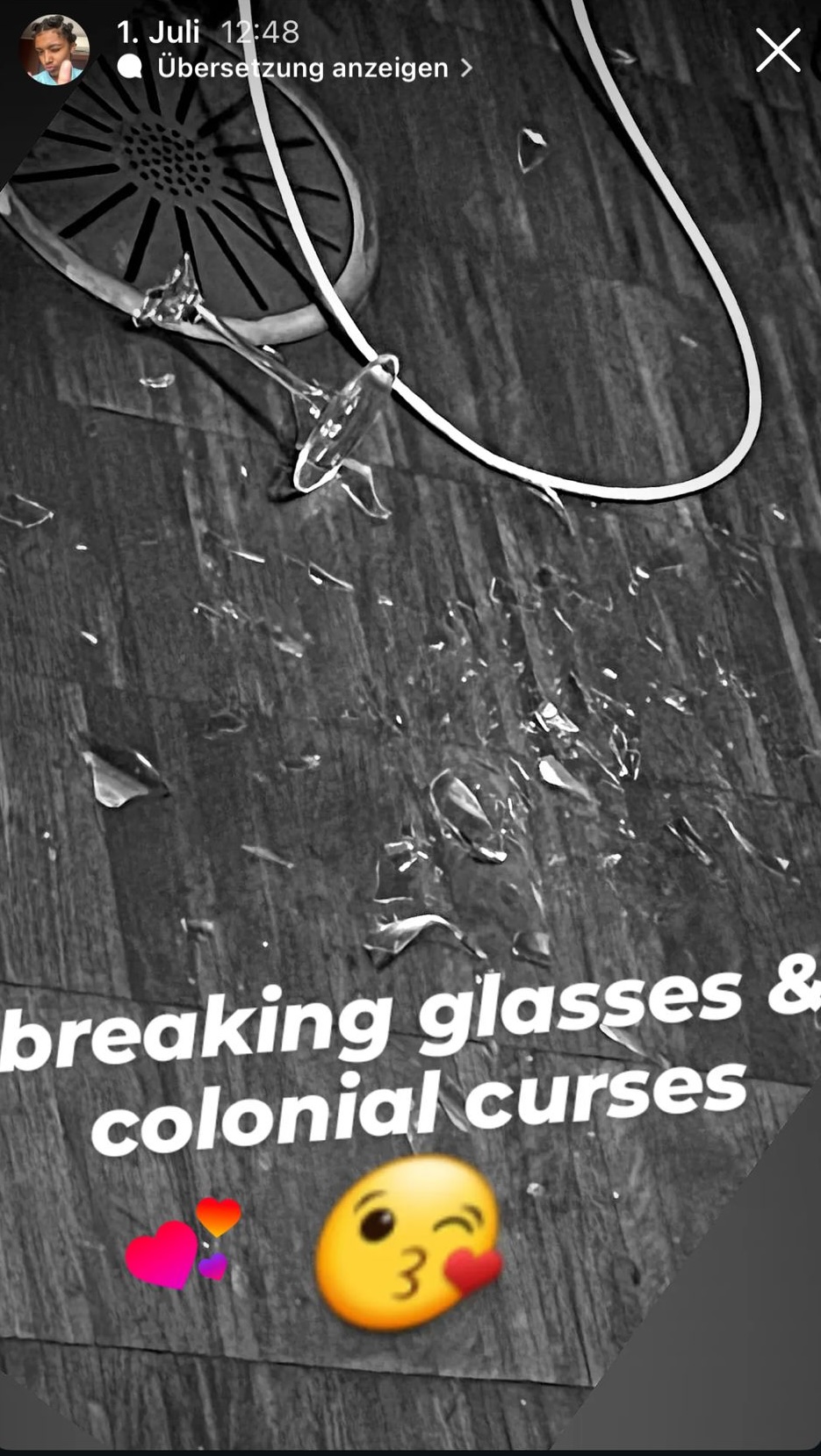
Complexity as the Joker, the trickster brings gifts. As we resonate with the spaces where we perform and rehearse, filters and years of dust fall out of the theatre lights, glasses fall down from the bar and neighbours complain. Even audience members come to, telling about losing shoulder pain or gaining memories of soundsystems in the 80s. Stefany Edegy wrote a beautiful article about the effects of low frequencies, they write about the healing process and the therapeutic significance of LFS on the body. As I play around, from a place of curiosity even the trickster is tricking me in finding new inspiration.
To close this first offering, here is a recording of a fragment of my performance TUNG.
Here, we use two low-frequency oscillators as the trickster, spinning their web through the space and your muscles. Musicians use a similar practice to tune their instruments,tuning the body through different rhythms and systems. One oscillator is slightly shorter than the other; therefore, they meet each other every time in a different place in space. Whenever they meet, they whisper. When they are far apart, they amplify. Fbeat = F1 - F2: 54 Hz - 50 Hz = 4 beats a second. When the speakers are far from each other, they can create moments of total silence, just like how noise-cancelling headphones bend the sound outside 180° around for silence inside.
By tuning these sounds, we find the frequency of the room and its objects, like two tuningforks that vibrate together when they have the same frequency. As the sound is loud and heavy, we allow the frequency to interact with the muscles, being picked up and let go every time a wave passes by, falling in and out of rhythm, allowing the trickster to create new pathways in our body.
The Garden spider is recognized by a huge cross on her back. I googled it; Christianity says that she got it while protecting Jesus from flies when he was crucified. I guess the spider symbolizes protection. But which story did the garden spider carry before Christianity? Through listening to diasporic longing, I invite the trickster to the colonial motherland. To see what crawls towards me in moments of silence.
