


Indische Kunstavond
in 2 acts
15th & 17th of March, 1916
Koninklijke Stadsschouwburg, Den Haag
On March 9th, 1916, a letter to the editor was published in De nieuwe courant, protesting some of the terminology that had been used in the advertising posters of a forth coming event at the Stadsschouwburg in Den Haag:
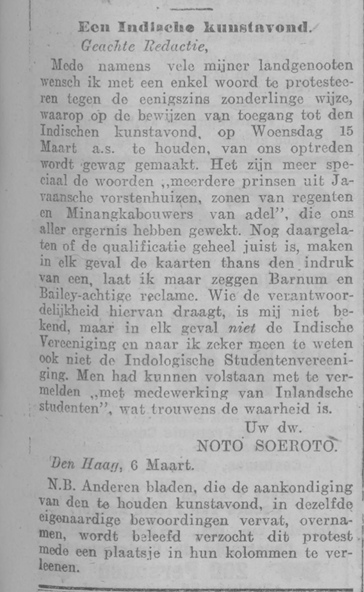
“…de kaarten [maken] thans den indruk van, laat ik maar zeggen, Barnum en Bailey-esque reclame…” The letter-writer, one of the organizers of the event in question, was indignant that the evening should have any connotation of popular entertainment, and rejected the idea that the backgrounds of the participants should be used to exoticize the event. Instead, what was on offer was to be an uplifting and serious artistic experience.
Noto Soeroto was a young Javanese poet[1] and student who was active in the Indische Vereeniging, an organization devoted to the interests of Indonesian[2] students living in the Netherlands. Together with members of the Den Haag department of the “Oost en West” and the Indologen Vereeniging, the students in Soeroto’s organization had prepared an “indische Kunstavond” as a benefit event for victims of flooding in central Java. This Kunstavond was the first of many held in the Netherlands before the Indonesian war of independence (Cohen 2014, p.237). At such evenings, the performing arts of the Dutch East Indies were presented to Dutch audiences in a mixed programme of dance, song, theater, recitations, and lectures (ibid). People of both Indonesian and Dutch descent participated in these evenings. Many people in the audience had first-hand experience with the colony. Some had been born and raised there, while others had worked for the colonial government, as civil servants, teachers, and soldiers. This first evening was supported by the elite of Dutch society, including the wife of the Governor-General of the Dutch East Indies (cf. “Het Indische avond”) and Queen Wilhelmina and her consort, who were present on the first evening.
It was thus very important to Soeroto that this first Indische Kunstavond should not be compared with a circus. This may have been because prior to this event, Indonesian arts in Europe were often put on display as entertainment for the masses: at world fairs, colonial exhibitions, and trade shows. The last time a gamelan had been played in the Netherlands outside of an academic context had been in 1898, at the Nationale Tentoonstelling van Vrouwenarbeid. The dancers and musicians from Java who appeared there were a group who had been touring Europe much as a travelling circus might, organized by a single Dutch impresario (Poeze 1986, p. 25). These artists lived and worked within the confines of their performing spaces and were kept largely sequestered from mainstream Dutch society. At one point on their tour, they lived and performed at the Wiener Zoo, another shameful chapter in a long history of people being exhibited at zoos in Europe (cf. Czarnecka&Demski 2021). They suffered so greatly from cold, homesickness, and frankly inhuman working conditions that they demanded to return home one year into their two-year contract. In contrast, the first Indische Kunstavond was presented at the largest theater in the Hague, in the presence of royalty and other high society. The performers were not professionals. Instead, most were university students from the Dutch East Indies, sent by their (wealthy) families to pursue higher education in business, law, and medicine. They were well educated in the customs and culture of their country of residence, and tailored this presentation of their culture(s) to the viewing habits of a European theater audience.
Soorjo Poetro, a cousin of Soeroto’s studying engineering in Delft, emceed that first evening, introducing each performance in impeccable Dutch anddressed according to Javanese adat (Cohen 2014, p. 240). At the beginning of the programme, the gamelan orchestra played the gendhing Munggang to welcome the royal pair instead of the national anthem, and then the gendhing Ricik Ricik to welcome the audience. The first half of the programme included several Javanese dance pieces and a procession of traditional costumes found in the archipelago. One Lt. Borgesius—well-known in the city for his likely brown-faced role in the “Indische drama” Totok en Indo then being played at the Theater Verkade—sang light-hearted kroncong[3] songs at the end of the first act. The second act began with the recitation of a Hindu legend by Ms. van der Harst. This was followed by several “Oriental songs” by Madame Sorga and then the Kelono dance, the debut of Raden Mas Jodjana. The concluding performance of the evening was a series of tableaux vivants featuring key moments in the “cultural evolution” of the inhabitants of the Dutch East Indies.
Since the beginning of the 20th century, Dutch colonial policy had been declared an “ethische politiek” (Poeze 1986, p. 23). The continued dominion of the Dutch over the East Indies was justified on the grounds that colonial subjects were as of yet incapable of autonomy. Thus ethische politiek was intended to educate the colonial population until they had acquired the social, political, and economical self-sufficiency necessary for independence. In other words, natives of the Dutch East Indies, being incapable of self-government, were fundamentally unequal to Dutch citizens in the Netherlands. In contrast, the Indonesian students around Poetro and Soeroto ably demonstrated their talent in organizing and performing in a sophisticated artistic programme that was even deemed to be more refined than what Dutch artists had to offer. As Henri Borel, a prolific journalist and frequent commentator on all things Asian, put it: “nooit heb ik in Europa zulk een zuiver, geestelijk kunstgenot van muziek, dans en tooneel ondergaan” (Borel in Poeze 1986, p. 109).
With the first Indische Kunstavond, the Indonesian students not only successfully distanced their arts, both physically and conceptually, from the circus, trade fair, and zoo. They also demonstrated their intimate knowledge of European viewing habits in their adaptation of their presentation to the tastes of the audience. It was almost playful to herald the Queen’s arrival with the gedhing Manggong instead of Het Wilhelmus. The spoken introduction, in Dutch, that preceded each act allowed everyone to understand what was going on. After the first four-hour evening, the programme was considerably shortened, with various acts condensed to make it the length of a “normal” evening at the theater. The structure of the evening and their comportment within it allowed the Indonesian students to confidently assert their fundamental equality with the majority Dutch culture—a first within the geographic confines of the Netherlands. At the time, there was no firm stance on what the future should hold for the Dutch East Indies, even within the Indische Vereeniging (cf. Poeze 1986). Some members were already pro-nationalist, whereas others (such as Soeroto and Soorjopoetro, likely because of their aristocratic backgrounds) favored a politics of assimiliation. The independence of Indonesia, of course, was still three decades away, but the performance of the first Indische Kunstavond introduced a new momentum to Dutch-Indonesian relations that would continue to build.
As mentioned above, Indische Kunstavonden became a popular genre in the interbellum years. Most evenings followed a recipe, the contours of which were apparent from the very first edition. First, such an evening was usually accompanied by a spoken or written text elucidating the various performances. This lecture-demonstration quality highlighted the fact that a) Indonesian performing arts were serious artistic endeavours (not circus!), and b) the audience watching them did not possess the necessary context for viewing them. Second, an Indische Kunstavond consisted of a variety of different acts: it nearly always had dances and songs from Java, not least because the gamelan in the Netherlands often came from this island, as did the majority of Indonesians living in the Netherlands pre-Second World War. Kroncong music, as a pop-cultural antidote to the refinement and slowness of Javanese dance, was also usually involved. Depending on who was performing, other cultural expressions could include Balinese dance, bamboo angklung music, a demonstration of the martial art pencak silat, more indigenous costumes, etc. Of a much more questionable authenticity (and dignity) were acts such as the brown-face of Lt. Borgesius, the recitation in “Hindoesche kostuum” by Ms. Van der Horst (cf. De nieuwe courant 1916), or the pentatonic scales of Madame Sorga. This points to the third and final commonality of the Indische Kunstavonden: the audience and performers were very often mixed, in many senses of the word, and in some ways that feel uncomfortable today. Indonesian and Dutch people performed together, as did colonizers and nationalists. Professionals performed alongside amateurs, and traditionalists with years of classical training performed with others who were indulging in pure Orientalist fantasies.
The Indische Kunstavonden petered out after the Second World War.[4] In their eclecticism and broad appeal, perhaps certain parallels can be found with these evenings and the curatorial choices of performances at the later Tong-Tong Fair. However, I was most strongly reminded of the Indische Kunstavond in one of the changeMakers’ works:
Cerita Kita is a series of performances curated by dance artist Cheroney Pelupessy: there have been three editions since 2022. For each edition Pelupessy invited artists with roots in the Indonesian archipelago, placing each act into one of the spaces of the monumental Felix Meritis building. The audience, in two groups, follows a tifa[5] player through the performance parcours. In the most recent edition, all of the performers were women, and large photos of female ancestors were on display in the foyer of the performance. The different artists each contributed traditional performing arts, although sometimes in innovative forms: Pelupessy herself presented her solo Rindu, which draws on Javanese dance techniques, another dancer performed Balinese dance. There was gamelan, and a pencak silat demonstration with fans, daggers, and choreography. One performer sang lagu lagu songs of the Malaku islands, accompanied by the ukulele. The work shows some parallels to the first Indische Kunstavond: in the diversity of art forms presented and thus also the diverse backgrounds of the artists themselves, as well as in the strategic decision of placing these performances within the monumental buildings of the Koninklijke Schouwburg and the Felix Meritis. However, the acts are not just on the stage in Cerita Kita, something for the audience to behold: Pelupessy goes further, embedding the traditional art forms of the Indonesian archipelago into the building. The audience not only looks, it must move to be able to understand. And this is perhaps a decisive difference to the Indische Kunstavonden: there is no emcee of the evening, no one to explain and frame what is going on, as Soorjo Poetro had felt obliged to do so long ago. Instead, the insistent throbbing of the tifa leads the audience through the building, its rhythms connecting the performance spaces and the audience. Cerita Kita investigates embodied heritage—Rindu, Pelupessy’s work, uses the metaphor of the umbilical cord to trace female lineage—and thereby insists that the experience of the music and dance of Indonesia has become (or should be) self-evident, in the Amsterdam of the 21st century: the art itself can be, must be, is enough.
_________________